Like many things in life, a lot of things in diving seem to
go in circles. Not quite the full
circles where we all go back to snorkels and weight belts but small circles
where you decide on a different direction and slowly end up realizing where you
were earlier was actually much better.
 |
| Early CCR days |
Both myself and Matti actually took our first CCR course on
the (exact) same unit under Tomas Morato; the Hammerhead Classic
rebreather. That was quite a few years
back now and since then I’ve gone through learning on, and owning, a few
different units including the ever versatile JJ-CCR (the good), the mistake of
the Hammerhead Inspro (the bad) and the UTD MX Rebreather (the ugly).
 |
| Monster CCR days |
None of the units I mention above seemed to have the
invincibility I felt with the Hammerhead (and also saw in the Meg), nor could
they offer the larger scrubber times I always had in the back of my mind for
those bigger dives we’re always planning (not planning, we definitely need to
get more focus on the doing this year!).
Sadly, the big draw back for me with the Hammerhead and the Meg was
always the over the shoulder counter lungs – having dived a few different back
mounted counter lung units I was already 100% sold on this concept and had no
intention of going back to over the shoulder lungs.
 |
| JJ-CCR for sale? |
The halleluiah moment for me arrived in February 2014 through
Mathew Partridge, ironically here to run through the JJ-CCR course with myself
and Alex. Mat had just been contacted by
Subgravity about becoming an instructor trainer for the Hammerhead unit. We had a 2 hour or so drive down to Anilao
from Manila and spent a lot of the time talking about the Hammerhead, the real
highlight for me been that Subgravity would be releasing the unit with back
mounted counter lungs as a standard option – the excitement of hearing this was
perhaps not as obvious as it should have been, the fact I’d just spent several thousand Euros on a JJ-CCR unit I already knew I would soon want to replace
probably helped keep things in perspective.
 |
| Matti in KL Airport with 'the goods' |
Fast forward to May 2014 and a lot of USD later, myself and
Matti are the proud owners of 2 shiny new Hammerhead Extreme CCR units – some
of the first new units off the production line and fully fitted out with the
back mounted counter lung design. The
units arrived in Malaysia which gave Alex and Matti the perfect excuse to visit
the MIDE dive show in KL while collecting the units, I was a bit tied up with
things at the time so didn’t have much free time and Alex kindly offered to go
for me if I bought his ticket – I’m also sure part of the agreement was he
would buy my half of the MDA JJ-CCR too but I don’t think we have that in
writing.
 |
| Familiar faces from Anilao in KL! |
Matti and Alex made a day trip to KL to pick up the units
and bump into some familiar faces.
Despite entering and exiting the country within 12 hours and carrying
back two large crates both Alex and Matti luckily managed to avoid the full
body cavity searches normally reserved for ‘day trip with 1 way baggage’
travellers – good news for them but it would have made an awesome story and for
that reason alone is actually a bit of a shame – maybe next time :-)
 |
| Freshly Opened Crates |
Upon receiving the crate of goodies the first thing we all
looked for was the new back mounted counter lungs, the suspense, excitement and
intrigue slowly draining away as we realized - they weren’t in the crate – they’d
be brought through to the Philippines by Randy Thornton, the CEO of both
Subgravity and Hammerhead, who would be conducting an instructor trainer course
for Mathew Partridge in the same week we would do our training. I guess good things are worth waiting for!
 |
| Gear! |
The training dates finally arrived and we were lucky enough
to have almost the whole of Acacia resort to ourselves for the whole week, with
just myself, Matti, Mat and Randy the only guest for the majority of the week. Sadly the weather wasn’t really up for
working with us and some very heavy rain coupled with some strong winds made
the shore diving from the resort akin to diving in chocolate milk…. with
waves…. and big rocks to climb over on the way in.
Ironically the weather for the first two ‘dry’ days was
pretty good, in fact by all accounts the visibility in Anilao was excellent,
reaching 20-30m on most of the sites – except the house reef which seem to be
lined up directly with the incoming waves.
We all got started on setting up out units together, except for Mat
who’d clearly come more prepared (or cheated) and already assembled half of his
unit back in Thailand.
 |
| New toys, new toys.... |
Building the unit up from scratch really helped in getting
to know where all the parts go, although it was a little time consuming. Our units were some of the first beta units
as mentioned above so we had a few teething problems with hoses working and 1
or 2 missing parts – luckily we had Randy at hand with the worlds largest
Hammerhead spare parts kit, based on future discussion everyone agreed it would
be better to have the units pre-assembled at the Hammerhead factory to ensure
everything works and fits, the student can then dismantle and rebuild the unit as
part of the course.
 |
| The Hammerhead Extreme Head and Handsets |
The quick connection bayonet attachments for the breathing
hoses and bail-out valve are just awesome, that's all I can say – nothing else
I’ve seen on other units comes close to these.
The new Extreme head is built like a tank and looks extremely solid, the
option to open up the head and remove the sensor pod is a nice feature and
makes drying out the head much easier.
 |
| Hammerhead Rev D Handset |
We
spent a few hours playing with the electronics and found some nice features,
having Randy’s advice was a great help as he knows the unit inside out and gave
us some neat short cuts and tricks regarding the controllers. For reference, all three of us had gone for
the new Rev D handset as the secondary display (to drive the new Extreme DIVA
HUD) and the Rev C+ OLED handset for the primary as the OLED displace is much
brighter than the Rev D display.

The only real problem we had with the unit set-up was some
worries with the head on Matti’s unit – it seemed the solenoid just wouldn’t
fire, but oddly if the sensor pod was removed it would start firing straight
away. This left all of us a bit confused
as it clearly wasn’t the solenoid itself, but something just wasn’t
working. A few hours of thinking,
playing and generally tinkering ensured but it turns out the problem was quite
simple – the solenoid was switched off in the primary controller menu; an easy
fix - once it’s diagnosed. It did show a
nice feature of the Hammerhead electronics, the solenoid will always fire if
the PPO2 drops below 0.19 (removing the sensors propped the PPO2 to 0.00 on the
controller), even in OC mode or when disabled – another nice feature is that
the solenoid is disabled (unless the PPO2 drops below 0.19) once the controller
is set to OC mode. The new extreme DIVA
HUD is very easy to read, looks well built and doesn’t obscure the view as
other HUDs seem too – the clear body may have something to do with this.
 |
| Awesomeness |
The first day ended with the unit completely assembled, bar
the scrubber, and ready for use in the water the following day. The resort was pretty much ours exclusively
from this night onwards and the Acacia deserts were awesome, even more awesome
than normal - almost as good as the new quick attachment bayonets I said
earlier with the most awesome thing ever.
I had two.
 |
| Dry diving |
Day two started bright and early with the packing and
installing the sort and moving onto some briefing using Mat’s ART ‘MONA LISA’
method, head to toe checks and dry diving skills. The skills on the Hammerhead are pretty
similar to other units although it’s neat the O2 doesn’t actually need to be
closed for bailing our or performing linearity checks if the controller is
switched to OC mode. The unit felt great
but sitting in the sun with a heavy unit on your back isn’t the most
comfortable position so getting into the water later that day was eagerly
awaited.
I was a bit concerned on my first pre-breath as I was
convinced I’d forgotten to put the scrubber into the canister – the radial
scrubber coupled with the cooper hoses and back mounted counter lungs made this
the beat breathing unit I’ve ever used, period.
And by far. I kept retracing my
steps and managed to convince myself I hadn’t forgotten to but in the scrubber
– I did double check with Matti too though, it really breathes that well. The new back mounted lungs initially looked very similar to what I had on the JJ, however it soon becomes evident they are quite a lot larger, this seems to have a big affect on the work of breathing and will have less problems with larger canister lights or inflation bottles reducing the lung volume as can be a problem on the JJ.
The make up of the lungs themselves looks solid, the two minor comments we had were that the velcro straps for the harness shoulder strap connection could be a bit thicker to help manage the hoses (all of us ended up using additional wraps/bungee to keep the hoses neat and tidy); also the velcro seems to be the wrong way around, the hook side can eaily end up against your neck which becomes a bit sore after a few days - minor issues only though and Randy seemed to think this would all be fixed in the next batch!
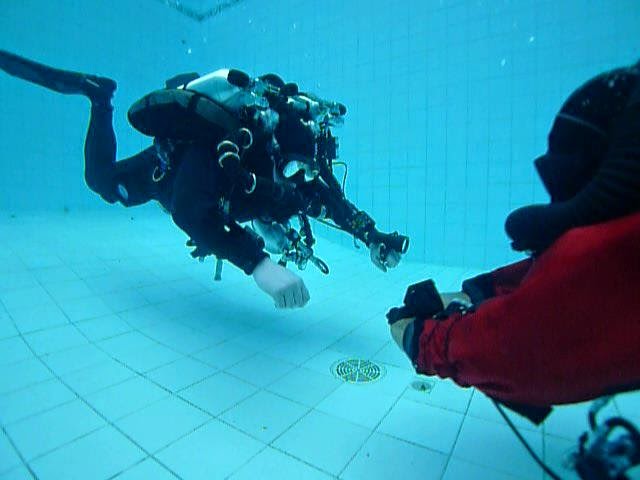
The pool skills went relatively smoothly, the
unit is well trimmed even with steel tanks and a wetsuit in fresh water;
another pleasant surprise. We’ve both
trained with Mat before, anyone who doesn’t know of Mat, in short, he’s absolutely
top notch, knowledge, experience and skills – Mat has everything and I don’t
think we’d even think about learning with anyone else.
It was getting a bit late and the weather was looking a
little rough by the time we finished so we decided to spend a bit more time in
the pool then do some theory work and hit the sea the following day; we still had plenty of time to finish
things off in the remainder of the week.
The deserts were again awesome, I had two again. We also had the chance to talk a lot more
with Randy and got to hear some of the amazing dive stories, the Papua New
Guinea trip and the Whale slapping incident and resulting medical treatment
were just incredible to hear first hand.
 |
| Theory |
The next morning started bring and early, well, dark and
early as the AC un it in our room decided to go crazy around 4am, then we realized
it was actually the rain; heavy doesn’t even come close to describing it. A few minutes later lightning struck
somewhere really close to the room that me and Matti were in, the floor was
shaking for a few seconds after that. By
the time the sun came up all of us were already awake and took and early
breakfast, the rain had stopped but the shore entry didn’t look good; run off
from the heavy rain had turned the shore line to a light brown soup which
wasn’t going to work for diving.
 |
| Pool skills done - check |
Given the conditions we decide to use the pool for more
skills, as both of us had already learned on similar units it was good just to
get some practice on the skills specific to the unit and how the unit felt
while operating it. Sadly the weather
didn’t improve much so we had an earlier finish for the day and saved ourselves
for the following day; as expected desert was awesome – I had three this time
as Alex had left and they had made one for him already.
 |
| Jeepney |
The following day arrived without heavy rain but the shore
entry was still looking a little wavy.
We all decided it was best to head to the other side of the Anilao
peninsular as we’d be sheltered from the waves there. This gave us the opportunity to show Mat and
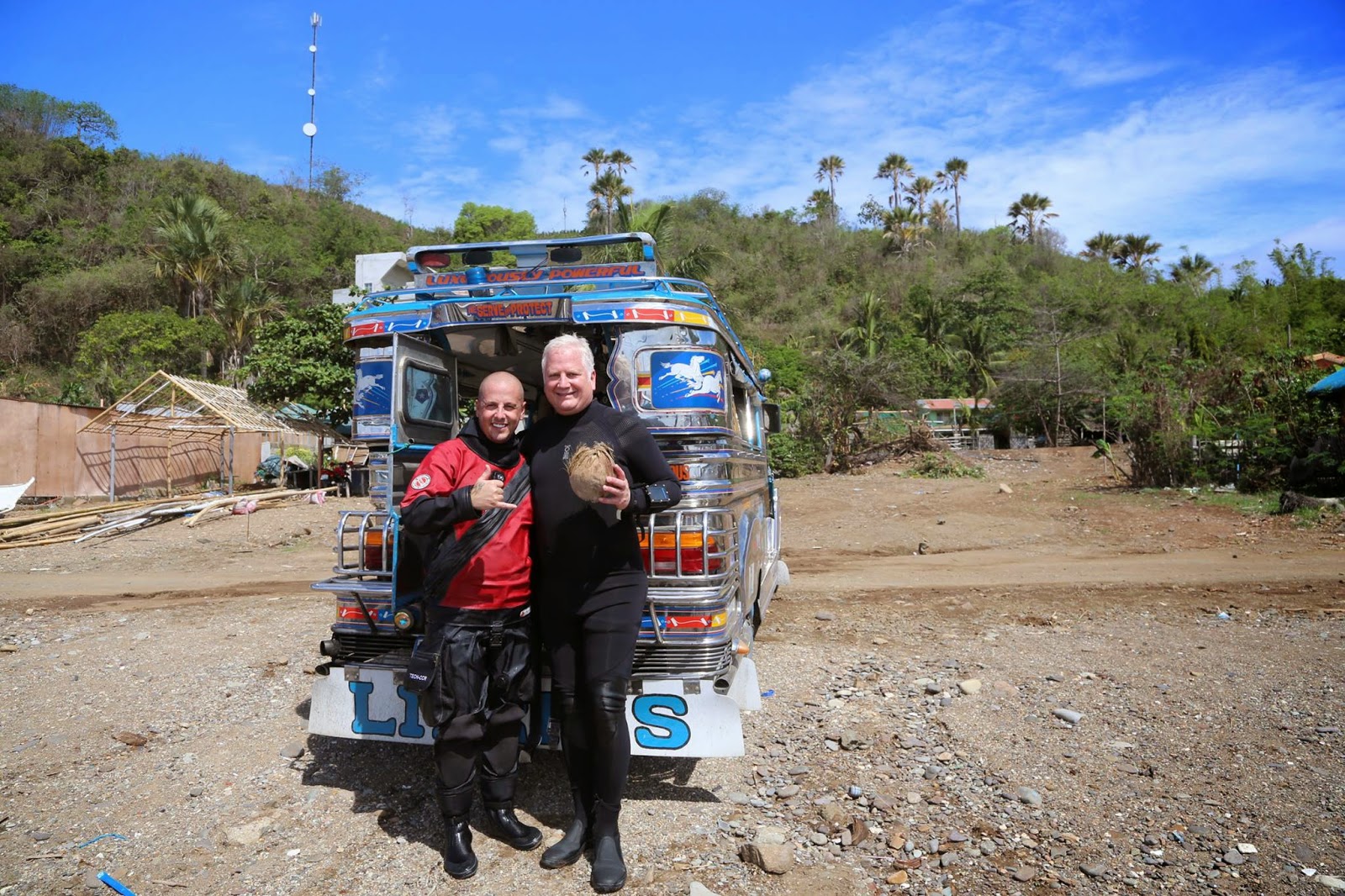
Randy something pretty unique to Philippines diving, the jeepney dive transport
– basically a rented jeepney used to take the dive gear from Acacia resort over
to Secret Bay as the sea was a bit rough in front of Acacia – it’s about a 10
minute drive between the two locations.
 |
| More Jeepney |
We were a bit late in setting off as the jeepney and
rebreather combo was too much of a good opportunity to miss and we spent a bit
of time getting pictures. The engine not
starting and smoke filling the cabin at the first attempt to start was a little
worrying but we were assumed it was no problem.
The second attempt involved removing the passenger seat to access the
battery, this time the engine didn’t start again but we didn’t get too much
smoke, just big flames – not looking good.
The third time it worked fine and started without any problems, everyone
looked happy although we were a little unsure given the smoke and fire a minute
earlier – we all sat near the back door exit for the trip there.
 |
| No Waves in Sight! |
Arriving at Secret Bay we were happy to see it was like
glass and not a single wave in sight. We
made two long dives with Mat and Randy covering the skills we’d been practicing
the previous day – all went well with the exception of no one bringing
sunscreen and everyone getting a little burned.
The trip back on the jeepney was a little less uneventful with no fires
or even smoke this time, we still all say close to the rear exit though.
Another awesome desert (I think I only had one this time
though, I ate too much other food before desert) and stories and we all called
it a night. The following day was
Randy’s last day at the resort before heading back to Manila so he left his
gear to dry out while we did a few dives from the front of the resort to close
out the course skills. We had a last
meal with Randy in Anilao before he left for Manila to catch an early morning
flight back to the US.
We’d already closed out the course skills in the previous
days so spent the final day on some fixable and non-fixable failures specific
to the Hammerhead unit. These exercises
with Matt really highlight where the thought process of CCR diving come in and
how the CCR units gives us so many more options that OC would. The only down side I can see to this unit as things stand is the back mounted counter lungs tend to close-up in a head down position, making breathing very difficult, especially with a minimum loop volume. This has been partially addressed using a small hose wrap straw although the breathing even with this is very difficult. We're going to play with some options using perforated larger diameter garned hoses inside the lungs to see how they work - we'll post an update shortly. It's pretty unlikely we'd be spending much time upside down but you never know how you can end up in a tight wreck or cave dive so we'd rather know we can solve this one before getting into a similar situation in an overhead environment.
 |
| Randy and Mat |
I haven’t gone into the skills in detail but if you’re
looking for a top CCR instructor I think we were lucky enough to have two of
the best in the business in Randy and Mat.
I was particularly impressed with how Randy listed to any feedback we
had and looked to take things onboard, the units we had were effectively beta
units after all but still work better than any other rebreather I’ve tried to
date – it’s now 100% my unit of choice and as a result I’m actively looking to sell both my
UTD MX and hopefully sell my half of a JJ to Alex.
The course was a blast from start to finish and both myself
and Matti are now keen to rack up the additional hours on the units with the
goal of teaching it at some point in the future – you’ll be seining us a lot on
these units!
Huge thanks go out to Randy and Mat, it's a honour to get to use some of the run of first units out of the factory and to learn from two of the best CR divers in the business. Thanks also to Acacia who (as always) provided a great base to dive from, and just in case it wasn't mentioned earlier - awesome deserts!


